What’s literary fiction? Literary fiction explores subtleties and complexities of language, theme and symbolism. It regularly has a tendency to be character-driven slightly than plot pushed. Learn a definition plus tips about how one can broaden literary writing taste.
How do you outline literary fiction?
When you learn the definition from Oxford Languages and the Cambridge Dictionary, mixed with different definitions from across the internet, it turns into transparent that literary fiction is:
- valued extremely for its high quality of shape, staying power and playful use of language
- writing positioned into the class ‘literature’ (books culturally approved as ‘literary’ as a result of they’ve not unusual options reminiscent of increased writing taste or dense allusion)
Examples of literary fiction come with the modernist writer Virginia Woolf’s guide To the Lighthouse and the novels of Nobel-winning authors reminiscent of Toni Morrison and J.M. Coetzee.
Not unusual options of literary fiction
Hard subject material, subject matters, or interpretive framework
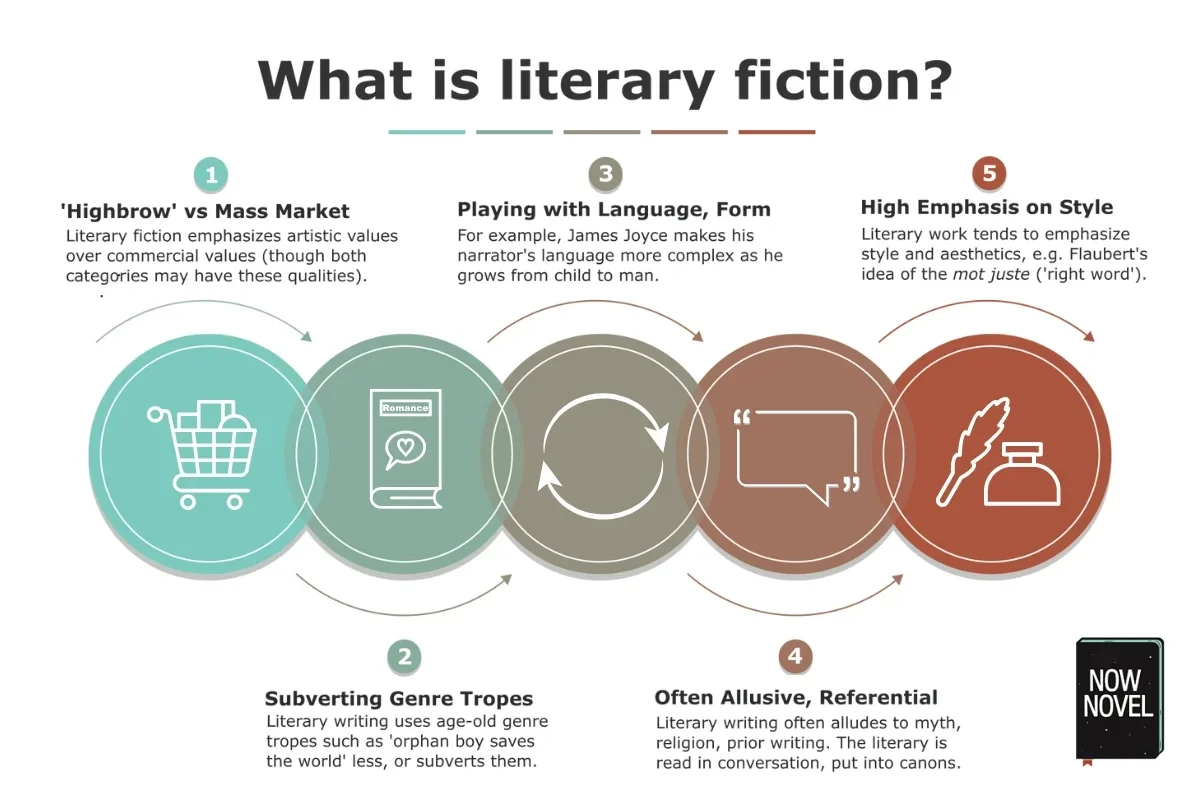
Continuously, literary fiction is extra ‘difficult’ than style fiction. Like style fiction, (or because it’s every so often recognized, industrial fiction), it’s going to use tropes such because the Hero’s Adventure, but might leave extra from anticipated conventions, too.
That is one explanation why many describe literary fiction as cerebral or ‘tough’. It has a tendency to require the reader to be extra lively within the act of creating that means and deciphering. It doesn’t at all times hand a decisive, singular interpretation to the reader, wrapped in a neat bow.
Literary fiction writers every so often have open-ended storylines, with the reader being left to come to a decision what the finishing would possibly or might be. It regularly, when written within the realist custom, has a high quality of actual existence, of the tale proceeding past the web page, because it have been. It regularly provides a deep dive into the nitty gritty of human studies. This sort of tale could be very regularly centered at the adventure, on what’s found out, than on attaining a suite finish level. As an example in a homicide tale, it is vital that the assassin be found out, readers of such fiction will be expecting it. Alternatively, in a literary whodunnit, the assassin might by no means be found out. The author could also be exploring subject matters reminiscent of guilt, or how the previous can wound a protagonist, or philosophical questions in regards to the that means of existence.
Right here’s a captivating and helpful definition from Nathan Bransford: ‘In industrial fiction the plot has a tendency to occur above the skin and in literary fiction the plot has a tendency to occur underneath the skin, and in literary fiction the prose has a novel, unique taste.’
A too-easy definition of literary and style fiction is that style fiction is extra dependent and curious about plot, whilst literary fiction is primarily based only on personality. Whilst that is true of a few novels in each and every camp, each and every tale will have to inform a tale, i.e. one thing will have to have occur. There needs to be a way that the nature(s) have found out one thing about themselves, or were modified through an revel in in a literary fiction novel, as an example.
Emphasis on context and milieu (in reception)
The subjects and subtexts or references of the textual content (regularly critical slightly than comedic) in literary fiction are regularly necessary.
Writing occurs in a context, in spite of everything. It occurs in position and time. A tale’s social and historic context (facets of studying that vary through the years) shapes (and shifts) how readers means it.
A part of that is because of the best way literary texts are given as set works and studied in instructional contexts. Crucial pondering calls for newbies to learn extra extensively, examine texts, situate them of their contexts (or create fascinating new conversations between them).
A tale’s literary standing isn’t static
Many books categorised literary have been written in previous centuries. The so-called classics.
Societal ideals and values alternate. Vocabularies do, too. Charles Dickens, now discovered on ‘Classics’ cabinets, was once the Stephen King of his Victorian instances. The best way he serialized standard tales reminiscent of The Pickwick Papers (1836) predates Kindle Vella.
Literary vs standard fiction: Blurring the road
Sooner than we speak about techniques to broaden your literary taste, we’ll in brief read about the ‘literature vs style’ debate, and the theory of style snobbery.
Literary is a bookshop class, no longer a style
So much has been written debating the deserves of literary fiction as opposed to style fiction (genres reminiscent of fable, romance, crime, mystery).
Elizabeth Edmonson, writing for The Mum or dad, as an example, argues that Jane Austen wasn’t writing ‘literature’ and that posterity made that call for her. In some respects it’s true that ‘literary fiction is simply suave advertising’, as her article’s identify suggests.
However what are some helpful variations?
Literary fiction might mix genres or create its personal
Many novels categorised as literary are merely tricky to categorize. Experimentation, subverting tropes or narrative conventions, would possibly weaken argument a tale suits this or that style, as an example.
Sui generis (Latin for ‘of its personal sort’) tales would possibly combine fictive parts with non-fiction.
Style fiction has a tendency to require of writers that you already know your style and ship on its guarantees. As an example, the reader is aware of they’ll in finding the meet lovely and thankfully ever after in feel-good romance. In a thriller novel the reader is aware of the thriller can be solved.
Now Novel writing trainer Romy Sommer stocks extra on figuring out your style within the writing webinar extract underneath:
Literary writers have explored hybrid style regularly. A number of of Margaret Atwood’s books discover science fiction or speculative subject matters, as did Kazuo Ishiguro’s By no means Let Me Cross. Doris Lessing began out as a literary writing, after which additionally printed science fiction, in addition to literary novels.
Graham Greene famously alternated between writing literary fiction and style thrillers whilst the Scottish literary author Iain Banks printed science fiction novels as Iain M. Banks.
Different literary books mash up more than one genres (David Mitchell’s Cloud Atlas, as an example, which combines historic, detective, dystopian and sci-fi parts).

Get a literary critique spouse
Paintings one-on-one with a writing trainer who understands literary taste.
Style fiction has a lot of literary fiction’s hallmarks
Even if some might say literary fiction is ‘artwork’ whilst style fiction is ‘mass marketplace’, can one say this in regards to the epic historic high quality of Tolkien’s The Lord of the Rings cycle?
Many essays or even entire books argue that Tolkien merits ‘critical’ find out about in literary and important institutions.
Some style fiction additionally issues itself with parts reminiscent of language and isn’t essentially plot-driven (a not unusual however false difference used to split style from the literary – plot-driven equals style, whilst character-driven equals literary).
Examples of writers who write or wrote style fiction however who’re literary within the breadth and intensity in their paintings come with Ursula Okay. Le Guin, John le Carré and Neil Gaiman.
Literary fiction and the style snob debate
Some argue that literary fiction is going hand in hand with snobbery or elitism. However literary novelists might come from any collection of backgrounds.
Whether or not or no longer you spot it as rarified, complicated or overwrought, literary fiction has a perfect deal to supply. When you most often write style fiction, studying literary fiction can display you techniques to make use of language and shape playfully – despite the fact that no longer reinventing the wheel solely does make certain the accessibility that is helping style fiction promote.
Whether or not your focal point is essentially style or literary fiction, listed here are one of the ways in which you’ll be able to broaden your personal literary taste:
Learn how to broaden literary taste in writing:
- Keep away from or subvert style clichés
- Learn literary writers
- Reproduction out passages from literary works you prefer
- Play with shape and narrative conventions
- Cross deeper with allusion and intertext
1. Keep away from or subvert style clichés
In some style fiction, heroines are at all times gorgeous, heroes at all times courageous. The detective at all times solves the crime. Folks are living thankfully ever after, and nice prevails over evil. Dangerous guys are unhealthy thru and thru.
There’s not anything mistaken with those clichés (or slightly, tropes – tale parts that recur and are recycled). Authors repeat tropes as a result of:
- They’re acquainted and recognizable and thus comforting – we all know what we’re entering into a James Bond film
- Readers of explicit genres have a tendency to be expecting them
- They regularly serve necessary tale parts reminiscent of plot construction, or characters’ targets, motivations and struggle
Learn how to make tales literary – undercut style tropes
Style fiction regularly offers us tropes reminiscent of ‘blameless orphan boy will have to save the sector’ (Famous person Wars, Harry Potter). Literary fiction regularly turns those regularly recycled concepts the wrong way up.
What occurs if against the law isn’t solved? David Lynch famously ended Dual Peaks (an overly postmodern – some would say ‘tough’ – TV display regularly requiring the viewer to attract their very own conclusions) on a detective turning into a imaginable antagonist. The tale thus opens out into worrying chance slightly than offering the relief of closure.
What if two folks transfer mountains to be in combination after which uncover they don’t in truth like one every other very a lot? In literary fiction this could be the basis for a sad or comedic tale.
The awful, violent, morally ambiguous global of George R.R. Martin’s Tune of Ice and Fireplace is a a long way cry from prime fable fiction wherein nice prevails. Patricia Highsmith’s Ripley crime novels don’t seem to be a few cranky detective catching a legal. As a substitute, they’re narrated through a sociopath.
Recall to mind techniques you’ll want to subvert or undercut what is predicted of style parts to your tale. It is a not unusual literary software, together with parody (which sends up or pokes amusing at standard style ploys).
2. Learn literary writers
You wish to have to learn the type of fiction you need to put in writing. Answering the query ‘what’s literary fiction?’ is more straightforward the extra you learn.
Take some time to learn one of the vintage writers (reminiscent of Toni Morrison, Virginia Woolf, Chinua Achebe and William Faulkner, as an example) in addition to recent writers.
Magazines reminiscent of The New Yorker, The Paris Assessment and Granta submit quick fiction through the highest literary writers of as of late.
Prizes such because the Booker and the Nobel Prize for Literature can level you in opposition to seriously acclaimed literary novels, too.
As you learn, understand the numerous several types of literary writers and the way writers like Gabriel Garcia Marquez or Helen Oyeyemi experiment with style or the fantastical. Alternatively, writers reminiscent of Alice Munro and Jonathan Franzen paintings in a extra realist storytelling – but nonetheless literary – vein.
Studying literary fiction avidly will permit you to perceive its conventions nicely. Whilst you attempt to write it, get started through imitating authors you’re keen on as a result of this will likely permit you to broaden your taste:
3. Reproduction out passages from literary works you prefer
Reproduction out sentences through well-known literary authors regularly. That is how Bach (regarded as probably the most largest masters of western classical track) discovered musical composition.
Along with copying passages phrase for phrase from the writers you respect, you may additionally attempt to write some passages of your personal and even a whole tale mimicking an writer’s taste.
John Banville wrote Mrs. Osmond as one of those literary-pastiche-meets-sequel after Henry James’ The Portrait of a Woman.
Copying writers you’re keen on is helping since you pay nearer consideration to the mechanics. You peel again the surface to look the bones that knit in combination an writer’s explicit writing taste and voice. This is helping you assimilate the weather you prefer, and clear out them thru your personal voice.
4. Play with shape and narrative conventions
Something you’ll understand as you learn literary fiction is how freely literary writers leave from narrative conference.
That is not anything new; many believe the 18th century novel Tristram Shandy through Laurence Sterne an early forerunner of twentieth century postmodern playfulness.
Within the early twentieth century, modernist writers like James Joyce and Virginia Woolf play with language and alter conventional narrative constructions. Many years later, David Foster Wallace’s Countless Jest instructed a lot of its tale by means of footnotes. In literary writing, we don’t have to breed conventional concepts about storytelling or ‘given’ paperwork.
In Latin and Central American writers creation magical realism into a few of their literary fiction. Damon Galgut’s Booker winner The Promise is a literary novel that performs with shape: it’s set over 4 funerals over time, and perspective regularly adjustments between characters, every so often inside the similar sentence.
Carmen Maria Machado’s Within the Dream Area performs round so much with the style of autobiography/memoir. JM Coetzee’s Dusklands is every other prototypical instance of telling the similar tale two times in several techniques in the identical guide.
In the meantime Anthony Horowitz’s Magpie Murders is a thriller novel through Anthony Horowitz and the primary novel within the Susan Ryeland sequence. The tale makes a speciality of the homicide of a thriller writer and makes use of a tale inside a tale layout.
Style has its experimental writers as nicely reminiscent of science fiction Samuel Delany. Mark Z. Danielewski, whilst no longer essentially a horror author, wrote a haunted space novel, The Area of Leaves, that upends each narrative and typographical expectancies.
5. Cross deeper with allusion and intertexts
Intertext – actually ‘between textual content’ – is a literary idea time period coined through theorist Julia Kristeva. It refers back to the means writing exists in dialog with different writing.
A trademark of literary fiction is that it regularly attracts on different writing. A technique it does that is thru allusion (as an example, the best way Aslan being resurrected in C.S. Lewis’ Narnia sequence calls to thoughts Jesus Christ).
A personality hesitating or taking a look again and dropping the entirety through doing so would straight away bring to mind (for the ones acquainted with it) the Greek fable of Orpheus and Eurydice.
Some literary texts actually rewrite or retell prior tales, from other or novel vantage issues. For instance, Jean Rhys in Broad Sargasso Sea (1966) tells the tale of Bertha, a secondary personality in Bronté’s vintage Jane Eyre (1847), from a extra feminist point of view. Additionally take a look at how Jane Eyre suits into the Hero’s Adventure from a feminist perspective. Thus even though it’s a literary novel, it makes use of a style trope, that of the Hero(oine)s Adventure.
How are you able to disguise easter eggs or allusions for the astute or well-read reader to find? Or how how would possibly you ‘write again’ to a prior tale, wondering a few of its blind spots, the issues or follies of its instances? Those are literary questions.
For a dialogue on how one can broaden your author’s voice, in any style, learn this information.
If you wish to get started and end writing a literary novel, get writing comments and lend a hand creating your guide on Now Novel.
It is a nice word (despite the fact that I’m no longer certain who’s overly obsessive about patting bottoms right here) – so long as it’s consensual! 🙂 Thank you for studying.
I totally loved studying this essay on literary fiction! Such nice issues and no, I don’t suppose it’s condescending to style writers in any respect.
I’m writing my first Literary Fiction novel after attending the Iowa Writers Workshop 26 years in the past.
I learn/pay attention to most commonly mystery And detective fiction. However I learn/pay attention to James Lee Burke, Greg Iles, and different authors who actually like to make use of language in shape and that means. I in finding there are lots of nice works in style fiction that move the traces.
Nice piece! I’m bookmarking this!
Hello Iowashorts, thanks for sharing that! It’s true, many works do blur the traces between the literary and the preferred. Thanks for studying our weblog and sharing your ideas, and nice good fortune together with your novel.
This was once very informative. Thanks for scripting this. I wish to write kids’s books. Does this data follow to that style and if it does, may just you suggest some examples?
Hello Angela, it’s a excitement, I’m satisfied you discovered this beneficial. I’d say it does no longer solely, as literary fiction is rather a long way from kids’s books in the case of taste, layout, tone and studying stage usually. Youngsters’s writer Alan Durant has a nice article on writing for more youthful readers for Penguin UK right here.
What about literary faction?
What about it, DF? Please proportion your ideas.
Fiction, fiction, fiction … why are such a lot of historic and particularly espionage novels thus? This can be a actual disgrace extra historic and espionage thrillers aren’t really truth primarily based. Courtesy of being fictional the readers’ revel in is narrowed and the additional dimensions to be had from studying truth primarily based books are misplaced. Factual novels permit the reader to investigate extra about what’s within the novel in press cuttings, historical past books and so forth and such analysis may also be as rewarding and compelling as studying a charming novel. Moreover, if even simply marginally autobiographical, the writer has the chance to put across the protagonist’s authentic hopes and fears versus hypothetical drivel about say what it feels love to keep away from seize. A nice instance of one of these “actual” espionage mystery is Past Enkription, the primary secret agent novel in The Burlington Recordsdata sequence through Invoice Fairclough. Its protagonist was once in fact an actual versus a celluloid secret agent and has even been likened to a “posh and complex Harry Palmer”. The primary novel within the sequence is surely noir, perhaps even a tad Deightonesque. If any person ever makes a movie according to Past Enkription they’ll solely have themselves accountable if it doesn’t cross down in historical past as a vintage espionage mystery.
Thanks for sharing your ideas about fiction vs historic/factual books, Daniel. An overly fascinating learn.
Something it made me bring to mind is how theorists of historic writing have posited that historical past may be written with agendas, issues of view, and different imaginative or ‘invention-oriented’ (for need of a higher phrase) rules, in order that historical past texts offered as non-fiction don’t essentially give us ‘non-diluted’ truths (or keep away from hypothetical drivel!). In some cases, historical past has been written through technologized victors, as an example, whilst the aspect of the tale in oral cultures is going untold – a minimum of in books.
So I trust a few of what you are saying, however I additionally like how studying fiction can lend a hand an individual to reach at a way of ‘fact and lie in an extra-moral sense’ (to borrow a word from Nietzsche), during the cracked reflect of invention.
to the query of why aren’t extra historic/espionage books truth primarily based? nicely as opposed to the massive query of whose model of occasions to base the tale on, I choose to put in writing made up worlds which can be *very* very similar to actual puts and occasions as a result of the zeitgeist, i.e. the worry of being torn down no longer at the advantage of the tale however at the ‘authenticity’ of the voice and placement.
Hello Jen, thanks for sharing your point of view and contributing to the dialogue. That’s true about factual writing, that it turns into a query of point of view and the way one offers with more than one variations of occasions or most likely contradictory assets. This is likely one of the the reason why some authors wish to mix factual and fictive parts (and provides a caveat {that a} tale is in part factual).
I have in mind a historical past textbook from my training days that had a unmarried, ‘grand narrative’, however then used textual content packing containers with micro histories during (particular person folks’s tales). This labored nicely as you were given a way of the extensive sweep of historical past, plus a chorus-like sense of more than one views and the other studies throughout elegance and ethnicity. Alternating viewpoints could be one solution to incorporate other assets like this in a narrative-only layout.
Following the recommendation to learn what you need to put in writing, are you able to suggest any recent literary fiction written in third-person omniscient POV? I’m new and having issue discovering that aggregate with my deficient seek skills.
Hello James, thanks in your query. What style are you writing? 3rd-person omniscient isn’t just about as standard as of late because it was once in earlier eras because it’s fallen out of style to a big extent as extra writers undertake both restricted 0.33 consumer, first consumer or multi-POV mounted viewpoints (as an example, a unique with 3 first-person narrators whose viewpoints exchange). A modern instance that involves thoughts (despite the fact that no longer that contemporary) is Markus Zusak’s The E-book Thief which is narrated through Loss of life personified. What confuses issues is I’ve noticed many lists proclaiming books to be third-person omniscient when they’re in truth multi-viewpoint 0.33 consumer. For it to be omniscient, a unmarried personality or non-involved narrator will have to be capable to know what is going on to (or has came about to) more than one characters; converting perspective by myself does no longer make the POV omniscient.
Hi, James! I’m newish, too. I’m no longer too willing at the trendy development of writing within the first consumer, both. Two years in the past, after I started my Mediocre American Novel, I believed I used to be writing in third-person omniscient. I quickly learned that I used to be the usage of third-person restricted. The POV every so often modified impulsively, however the reader by no means gained data hidden from the characters.
Thanks for becoming a member of the dialog, Kathy! I really like ‘Mediocre American Novel’, haha. I’m guessing it’s a riposte to the theory of the ‘Nice American Novel’.
Overly obsessive about patting the ground of style fiction.